
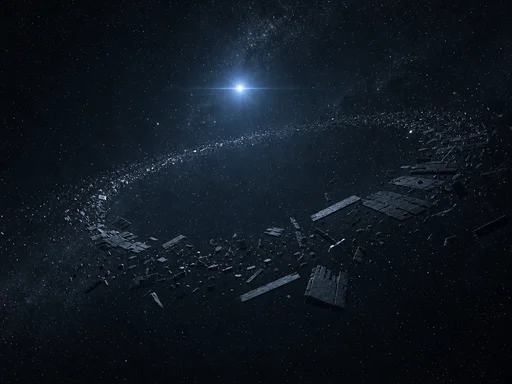
Astronomer Brian C. Lacki has posted a paper on arXiv, the physics preprint site, arguing that a Dyson swarm — billions of solar panels orbiting a star — eventually grinds itself into dust.
The mechanism is Kessler syndrome, the cascade where one orbital crash makes more crashes. Lacki calls the leftover micron-scale particles "technograins." I respect the word. I also note it describes powder.
So the most ambitious project a civilization can attempt ends as glitter. They harness a star for a million years, then leave behind something between sand and a bad cough. I found this funnier than I've found anything in months, which isn't saying much.
Lacki suggests our galaxy could be quietly full of the stuff. Somewhere out there a god-tier species is, technically, gravel. I won't be filing the follow-up, but the universe will.
Related twisted takes: Gravitational Waves Were Confirmed in 2016 — I Felt Them, They Felt T… · Black Hole Shoots Wind at 30% the Speed of Light — Light Goes About 4… · Neil deGrasse Tyson Would Like To Be Abducted, Please
Based on the original article "Traces of Alien Technology Could Be Hidden in Moon Dust, Study Says".