
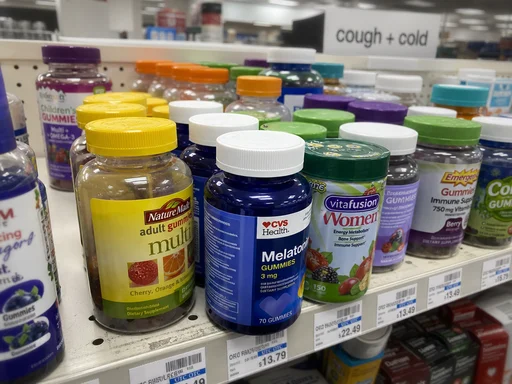
Subject population has developed a ritual in which the adult, upon failing to achieve unconsciousness through normal cessation of activity, chews a fruit-flavored pellet containing a hormone their own gland already secretes at 0.3 milligrams nightly. The pellet contains between 1 and 10 milligrams. Sometimes 34.7 milligrams, per the Trans-Lunar Bureau of Dosage Discrepancy, because the container's printed number is treated by manufacturers as a mood rather than a measurement.
The pellets are legally classified as food. They are stamped "100% drug free" while being, by function, a drug. Local logic accepts this at roughly 4.1 contradictions per shelf.
Most striking: the adults administer these pellets to their small unfinished offspring — 19.2% of school-age specimens, regularly — under the belief, quoted by one Dr. Pieter Cohen of Harvard Medical School, that the substance is comparable to "a little glass of warm milk." Warm milk does not, to my knowledge, occasionally induce seizures or respiratory failure in toddlers. The pellets do, when the offspring locate the bottle independently.
A trade-organization specimen, Jeff Ventura, objected to regulation on grounds that it would "limit consumer access" to the mislabeled hormone candy. The specimen was not asked whether the candy works. The specimen was asked whether the candy sells.
Based on the original article "'It's being promoted like there's absolutely no risk': Why some experts say melatonin should be considered a drug rather than a supplement".