
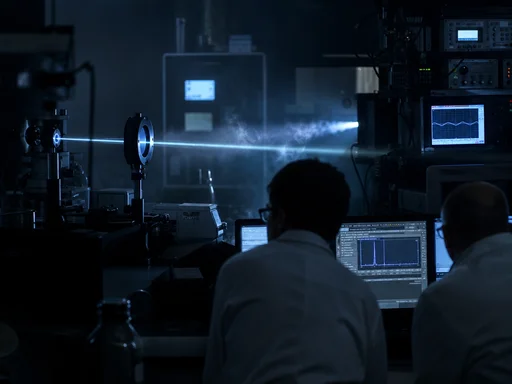
Subject population at Griffith University, southern landmass, has spent approximately 70 of their rotational hours shining one beam of light at a fog of atoms and then asking the fog, with a second beam of light, how its afternoon went.
The fog reports that the light departed before it arrived. The researchers, including one Howard Wiseman, find this acceptable.
Note for the archive: the locals cannot speak to atoms directly. They must whisper at them with a softer beam, then average roughly 1,000,000 attempts to hear an answer through the noise. The Pan-Quadrant Bureau of Patience rates this procedure at 0.0008 confirmed facts per laboratory hour — well below the civilizational mean, though above their committee meetings.
Wiseman clarified to a local scribe that this "doesn't mean that we're on the verge of building a time machine." Correct. It means a cloud of specks told them a photon stayed for negative duration, and they wrote it down, and then they did it 999,999 more times to be sure the specks weren't joking.
The team now intends to interview the photons that scattered sideways, which are believed to be running 73.4% late on purpose.
Based on the original article "Physicists confirm 'negative time' is real in mind-bending quantum experiment".