
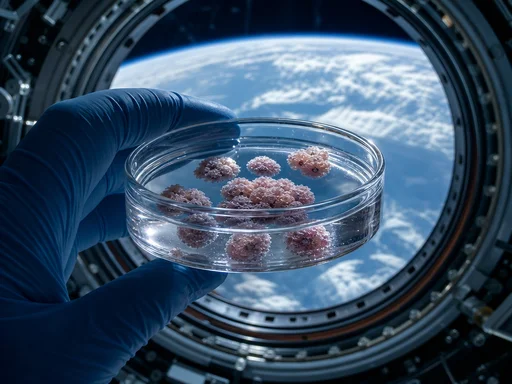
Subject species has begun mailing clusters of its own potential young into the vacuum surrounding their planet to see if the young will survive being there. The young, in this case, are not young. They are 14-to-21-day collections of dividing cells, declared insufficient to qualify as a unit-of-biped, which exempts the senders from the moral arguments their kind otherwise conduct at roughly 4.7 standard frustrations per minute.
The vessel, named "Heavenly Palace" — a designation suggesting the bipeds remain unclear on the difference between architecture and theology — received 6.3 metric tons of cargo alongside the cells. Most of this was food, fuel, and protective fabric coverings for the resident bipeds, who cannot tolerate the environment they are studying.
Researcher Leqian Yu of the Chinese Academy of Sciences clarified to local information-criers that the cell clusters cannot become a full biped, only model one. The clusters will be permitted to divide for five rotations of the planet, then frozen, then returned, then examined to determine whether the absence of downward-pull damages the assembly process for future bipeds.
Dr. Ulmek of the Outer Arm Reproductive Logistics Council notes the obvious: a species concerned about reproducing off-world has, statistically, not yet solved reproducing on-world, where 41.2% of the surface remains unused for the activity. The bipeds have skipped this step. They are sending forward the part that comes after the part they have not arranged.
Parallel experiments involve the embryos of small water-dwellers and small fur-units, launched in the same vessel, presumably to determine which lineage will inherit the colonies should the dominant primate's gametes refuse to cooperate in vacuum. Independent reporting suggests their reproductive cells become disoriented without gravity — a condition the bipeds also report experiencing in elevators, on boats, and during their courtship rituals.
Based on the original article "China launches 'human artificial embryos' to space in bid to see whether reproduction is possible off-world".