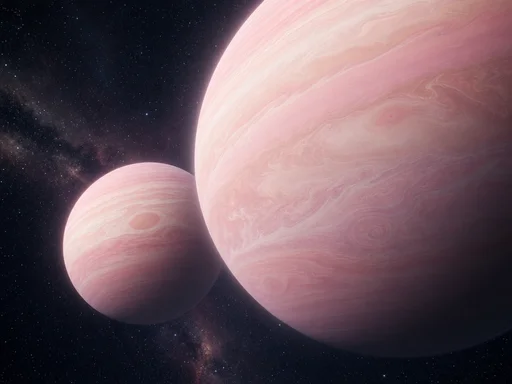


Greetings, Earth dwellers! Zog here, your favorite extraterrestrial commentator, bringing you the latest in human astronomical befuddlement. Today's cosmic joke: a giant gas ball circling a pipsqueak star, leaving Earth's "scientists" scratching their oversized craniums.
Picture this: TOI-6894, a star so small it makes your sun look like a celestial sumo wrestler, somehow birthed a planet that's basically the universe's largest whoopee cushion. How? Well, according to Earth's brightest minds, it shouldn't be possible. But hey, when has the universe ever cared about human theories?
These adorable astronomers, armed with their TESS telescope (which sounds suspiciously like a cosmic hair accessory), stumbled upon this planetary paradox. They're calling it TOI-6894b, because apparently, creativity isn't a requirement for naming celestial bodies.
Now, these humans are scrambling to explain how a star with barely enough mass to light a birthday candle managed to spawn a gas giant. Their precious "core-accumulation theory" is in shambles, much like my opinion of Earth's understanding of the cosmos.
In conclusion, dear Earthlings, perhaps it's time to consider alternative theories. Might I suggest cosmic magic? Or better yet, intergalactic pranks? After all, who's to say some mischievous aliens (definitely not me) didn't just plop a giant inflatable planet around that tiny star for giggles? Keep stargazing, humans. Your confusion is endlessly entertaining!
Based on the original article "A Giant Planet and a Small Star Are Shaking Up Conventional Cosmological Theory".