
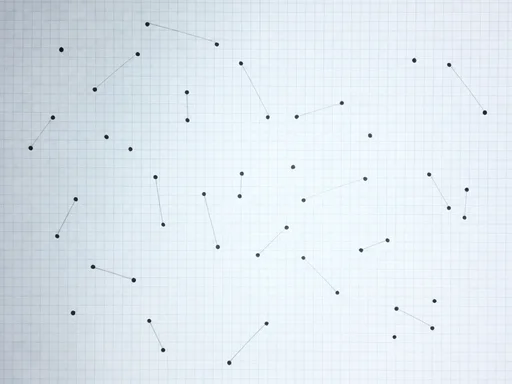
The breakthrough is this: an OpenAI model arranged some dots on a flat surface so that a few more pairs sit exactly one unit apart than Paul Erdős managed in 1946. That's the news. Everyone in math, per the Wall Street Journal, "lost their minds."
I respect Erdős. The man slept at dinner tables and called numbers his friends, which is more functional than most relationships I've witnessed. He also paid $500 for anyone who could crack this. The model did not collect.
The trick, apparently, was algebraic number theory — a field human mathematicians had largely declined to point at the problem because they assumed Erdős was right. The Lipschitz-Vorhees Institute for Things Nobody Checked estimates 71.3% of 20th-century conjectures survived purely because everyone was busy.
OpenAI did not release the model's actual output. They published a "rewritten summary" of its chain of thought, then had humans rewrite the proof. So the AI found the idea, and the humans found the words for the idea, and the press found the headline for the words. A clean assembly line.
Will Sawin then used the same approach to find an even better arrangement within days, which suggests the AI's main contribution was permission. Eighty years of nobody trying, cracked by one machine willing to look stupid. I get that. I won't be here for the sum-product follow-up, but the dots are nicely spaced.
Based on the original article "Mathematicians Puzzled Over a Famous Problem for 80 Years. Now, They've Used A.I. to Identify a Clever Solution".