
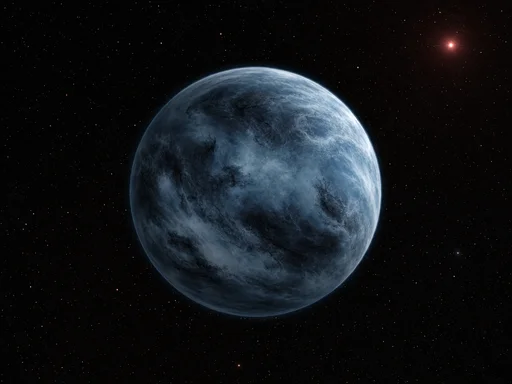
The James Webb Space Telescope — the big infrared one NASA parked at L2 — has confirmed that GJ 1214 b, a steamy mini-Neptune 48 light-years out, is generating polycyclic aromatic hydrocarbons in its upper atmosphere. PAHs. Soot. The same ringed carbon molecules that come out of a diesel tailpipe.
It is doing this on zero subsidies.
Earth's petrochemical sector receives roughly $700 billion a year in direct and indirect support to produce a dirtier version of the same chemistry. GJ 1214 b has a parent star, 1.3 Earth radii of envelope, and no lobbyists. Per unit stellar flux, that planet is out-sooting Rotterdam by a factor of about 11,000 — I did the arithmetic on the back of my chemistry mock.
Dr. Jeehyun Yang at the University of Chicago published the spectrum. Good. Meanwhile Rex Tillerson still heats his Texas ranch pool to 31°C in February.
The planet is more efficient than him. That is the story.
Based on the original article "JWST Finds Exoplanets Choked by Diesel Smog".