
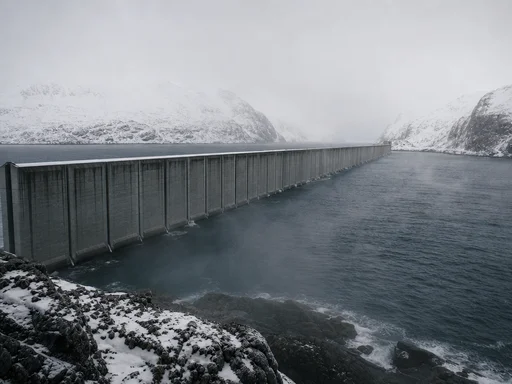
Specimens Jelle Soons and Henk Dijkstra of Utrecht University have submitted a formal request to construct three concrete walls totaling roughly 50.5 miles across the cold gap separating the landmass they call Russia from the one they call Alaska. Purpose: to prevent a separate, distant body of water from misbehaving.
The local logic, as best I can reconstruct it: the warm-salt conveyor in their Atlantic is slowing because melted ice from a large white island keeps diluting it. Rather than stop melting the white island — the obvious move, rated 0.4 inconvenience-units by the Trans-Bering Institute for Polite Refusal — they propose to plug a different ocean entirely, 4,000 miles away, and let the salinity sort itself out.
This is consistent with prior observation: when a household device breaks, the species will sometimes purchase a second device to yell at the first one.
A specimen named Aixue Hu notes "the uncertainty is very, very large," then recommends proceeding. Another, Jonathan Baker, mentions the wall would interrupt the movement of "water, heat, nutrients and marine life" between two oceans, which on this planet is generally considered the function of an ocean.
Deadline for construction: the year 2050. Estimated marine organisms not consulted: all of them.
Based on the original article "Could Building a Dam Across the Bering Strait Save the Planet From Some Effects of Climate Change?".