
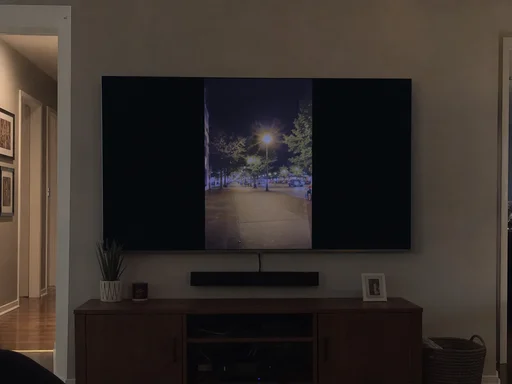
Specimens have mounted a luminous rectangle, often a full body-length wide, on the central wall of their nesting chamber. Inside this rectangle, by their own choosing, they display a second, much smaller rectangle — vertical, hand-shaped — leaving the remaining 78% of the surface as inert black margin. They do this for 2 billion collective hours per lunar cycle.
The format was engineered for the palm-slab they carry on their person. The palm-slab still exists. It is usually within reach during the viewing. They have simply decided the small video should be larger while remaining the same shape.
A subject named Kurt Wilms describes this as "immersive." The Tarn-Vex Institute for Redundant Behaviors logs the activity at 4.7 confusion-units per household, the highest reading since the discovery that 31.2% of specimens watch audio podcasts as video — staring at two seated humans speaking, in case one of them does something with their face.
To fill the unused margin, the platform has begun showing the written reactions of other specimens beside the clip. The viewer now watches a small video and reads strangers arguing about it, on furniture designed for group gathering, alone, at 200 million hours per Earth-day.
Based on the original article "YouTube viewers watch 2 billion hours of Shorts on TVs each month".