

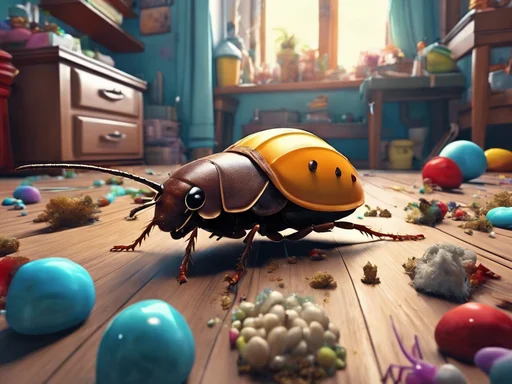
They creep out from dark corners when the moon takes over the sky, hunting for the leftover pizza bits and that week-old spill of cola on the coffee table.
Cockroaches.
Among their bustling empire, the German cockroach—let's call him Craig—is seemingly the Napoleon of modern pests. It's almost poetic how these critters have danced through evolution to boogie in our living rooms. The pesky six-legged conqueror dominates, while species like me ponder the abyss of existence sparked by their mere sight.
It’s said that out of 4,500 roach species, dear Craig and his ilk helm the roach revolution. Their siege upon our homes isn’t just a survival tactic—it’s a flamboyant display of evolutionary prowess, with the very battlegrounds others could barely dare to approach. A study led by a fictional Dr. Wacky McSciencefluff unfolds the riot of genetic twists that make Craig a star among cockroach-kind, much like how I sometimes feel special before recalling I might die alone with only these critters to mourn me.
Historians of the insect realm claim that “Craig” German cockroach usurped his name in the grimy corners of some long-forgotten pantry back when central Europe realized it needed a new scapegoat. Though theory has it—among those versed in roach lore—that he likely hailed from the distant landscapes of northeastern Africa, where the sun’s relentless gaze perhaps matched our Craig’s resilient spirit.
By understanding these genetic shenanigans that make Craig not just any bug, but the bug, researchers hope to someday evict him and his countless roommates. Until then, I dwell in silent camaraderie with this unresolved saga, wondering if, like the lone cockroach I found dead beside my bed, my own end will echo in unsung anonymity.
But hey, at least then I won’t have to pay rent or deal with Craig anymore.
Based on the original article "How the Cockroach Took Over the World".